Wednesday, 21 November 2012

Importance of craft


crafts are important subject in schools, they help with thinking and to concentrate thoughts and they should be taken seriously and recognised as a valid part of child development.
Through learning to work with our hands and with different materials we can also become more self sufficient and innovative, be able to repair things and have the confidence to tackle jobs ourselves.  Rudolf Steiner said that the purpose was not to train weavers, potters, etc., but rather for the pupils, by practicing such work to be able to stand more secure on leaving school, with a basic confidence for managing the practical affairs of life.  These things can never be achieved unless we all recognise craft as a valid and important part of child development and give it a proper place in education.


Art definition


Works of art can tell stories or simply express an aesthetic truth or feeling. Panorama of a section of A Thousand Li of Mountains and Rivers, a 12th-century painting by Song Dynasty artist Wang Ximeng.
The Encyclopædia Britannica Online defines art as "the use of skill and imagination in the creation of aesthetic objects, environments, or experiences that can be shared with others". By this definition of the word, artistic works have existed for almost as long ashumankind: from early pre-historic art to contemporary art; however, some theories restrict the concept to modern Western societies.[6]The first and broadest sense of art is the one that has remained closest to the older Latin meaning, which roughly translates to "skill" or "craft." A few examples where this meaning proves very broad include artifactartificialartificemedical arts, and military arts. However, there are many other colloquial uses of the word, all with some relation to its etymology.
20th-century Rwandan bottle. Artistic works may serve practical functions, in addition to their decorative value.
In medieval philosophy, John Chrysostom held that "the name of art should be applied to those only which contribute towards and produce necessaries and mainstays of life."Thomas Aquinas, when treating the adornment of women, gives an ethical justification as to why: "In the case of an art directed to the production of goods which men cannot use without sin, it follows that the workmen sin in making such things, as directly affording others an occasion of sin; for instance, if a man were to make idols or anything pertaining to idolatrous worship. But in the case of an art the products of which may be employed by man either for a good or for an evil use, such as swords, arrows, and the like, the practice of such an art is not sinful. These alone should be called arts."[7] Aquinas held that art is nothing else than "the right reason about certain works to be made," and that it is commendable, not for the will with which a craftman does a work, "but for the quality of the work. Art, therefore, properly speaking, is an operative habit." Aristotle and Aquinas distinguish it from the related habit of prudence.[8]
The second and more recent sense of the word art is as an abbreviation for creative art orfine art and emerged in the early 17th century.[9] Fine art means that a skill is being used to express the artist's creativity, or to engage the audience's aesthetic sensibilities, or to draw the audience towards consideration of the finer things.
The word art can refer to several things: a study of creative skill, a process of using the creative skill, a product of the creative skill, or the audience's experience with the creative skill. The creative arts (art as discipline) are a collection of disciplines that produceartworks (art as objects) that are compelled by a personal drive (art as activity) and convey a message, mood, or symbolism for the viewer to interpret (art as experience). Art is something that stimulates an individual's thoughts, emotions, beliefs, or ideas through the senses. Artworks can be explicitly made for this purpose or interpreted on the basis of images or objects. Although the application of scientific knowledge to derive a new scientific theory involves skill and results in the "creation" of something new, this represents science only and is not categorized as art.
Often, if the skill is being used in a common or practical way, people will consider it a craft instead of art. Likewise, if the skill is being used in a commercial or industrial way, it may be considered commercial art instead of fine art. On the other hand, crafts and designare sometimes considered applied art. Some art followers have argued that the difference between fine art and applied art has more to do with value judgments made about the art than any clear definitional difference.[10] However, even fine art often has goals beyond pure creativity and self-expression. The purpose of works of art may be to communicate ideas, such as in politically, spiritually, or philosophically motivated art; to create a sense of beauty (see aesthetics); to explore the nature of perception; for pleasure; or to generate strong emotions. The purpose may also be seemingly nonexistent.
The nature of art has been described by philosopher Richard Wollheim as "one of the most elusive of the traditional problems of human culture".[11] Art has been defined as a vehicle for the expression or communication of emotions and ideas, a means for exploring and appreciating formal elements for their own sake, and as mimesis or representation. Art as mimesis has deep roots in the philosophy ofAristotle.[12] Goethe defined art as an other resp. a second nature, according to his ideal of a style founded on the basic fundaments of insight and on the innermost character of things.[13] Leo Tolstoy identified art as a use of indirect means to communicate from one person to another.[12] Benedetto Croce and R.G. Collingwood advanced the idealist view that art expresses emotions, and that the work of art therefore essentially exists in the mind of the creator.[14][15] The theory of art as form has its roots in the philosophy of Immanuel Kant, and was developed in the early twentieth century by Roger Fry and Clive Bell. More recently, thinkers influenced by Martin Heidegger have interpreted art as the means by which a community develops for itself a medium for self-expression and interpretation.[16] George Dickie has offered an institutional theory of art that defines a work of art as any artifact upon which a qualified person or institution has conferred "the status of candidate for appreciation".[17]

Art,class and value


Art, class, and value

Versailles: Louis Le Vau opened up the interior court to create the expansive entrance cour d'honneur, later copied all over Europe.
Art is sometimes perceived as belonging exclusively to higher social classes. In this context, art is seen as an upper-class activity associated with wealth, the ability to purchase art, and the leisure required to pursue or enjoy it. ThePalace of Versailles and the Hermitage in St. Petersburg illustrate this view: such vast collections of art are the preserve of the rich, of governments and wealthy organizations.
Fine and expensive goods have been popular markers of status in many cultures, and they continue to be so today. There has been a cultural push in the other direction since at least 1793, when the Louvre, which had been a private palace of the Kings of France, was opened to the public as an art museum during the French Revolution. Most modern public museums and art education programs for children in schools can be traced back to this impulse to have art available to everyone. Museums in the United States tend to be gifts from the very rich to the masses (The Metropolitan Museum of Art in New York City, for example, was created byJohn Taylor Johnston, a railroad executive whose personal art collection seeded the museum.) But despite all this, at least one of the important functions of art in the 21st century remains as a marker of wealth and social status.
Performance by Joseph Beuys, 1978:Everyone an artist — On the way to the libertarian form of the social organism
There have been attempts by artists to create art that can not be bought by the wealthy as a status object. One of the prime original motivators of much of the art of the late 1960s and 1970s was to create art that could not be bought and sold. It is "necessary to present something more than mere objects"[47] said the major post war German artist Joseph Beuys. This time period saw the rise of such things as performance artvideo art, andconceptual art. The idea was that if the artwork was a performance that would leave nothing behind, or was simply an idea, it could not be bought and sold. "Democratic precepts revolving around the idea that a work of art is a commodity impelled the aesthetic innovation which germinated in the mid-1960s and was reaped throughout the 1970s. Artists broadly identified under the heading of Conceptual art... substituting performance and publishing activities for engagement with both the material and materialistic concerns of painted or sculptural form... [have] endeavored to undermine the art object qua object."[48]
In the decades since, these ideas have been somewhat lost as the art market has learned to sell limited edition DVDs of video works,[49] invitations to exclusive performance art pieces, and the objects left over from conceptual pieces. Many of these performances create works that are only understood by the elite who have been educated as to why an idea or video or piece of apparent garbage may be considered art. The marker of status becomes understanding the work instead of necessarily owning it, and the artwork remains an upper-class activity. "With the widespread use of DVD recording technology in the early 2000s, artists, and the gallery system that derives its profits from the sale of artworks, gained an important means of controlling the sale of video and computer artworks in limited editions to collectors."[50]

Purpose of art

Art has had a great number of different functions throughout its history, making its purpose difficult to abstract or quantify to any single concept. This does not imply that the purpose of Art is "vague", but that it has had many unique, different reasons for being created. Some of these functions of Art are provided in the following outline. The different purposes of art may be grouped according to those that are non-motivated, and those that are motivated (Levi-Strauss).


What is art?


Clockwise from upper left: a self-portrait from Vincent van Gogh, an African Chokwe statue, detail from the Birth of Venus by Sandro Botticelli and a Japanese Shisa lion
Art is a diverse range of human activities and the products of those activities; this article focuses primarily on the visual arts, which includes the creation of images or objects in fields including paintingsculptureprintmaking,photography, and other visual media. Architecture is often included as one of the visual arts; however, like the decorative arts, it involves the creation of objects where the practical considerations of use are essential—in a way that they are usually not for a painting, for example. Musictheatrefilmdance, and other performing arts, as well as literature, and other media such asinteractive media are included in a broader definition of art or the arts.[1] Until the 17th century, art referred to any skill or mastery and was not differentiated from crafts or sciences, but in modern usage the fine arts, where aesthetic considerations are paramount, are distinguished from acquired skills in general, and the decorative or applied arts.
Many definitions of art have been proposed by philosophers and others who have characterized art in terms of mimesis, expression, communication of emotion, or other values. During the Romantic period, art came to be seen as "a special faculty of the human mind to be classified with religion and science".[2] Though art's definition is disputed and has changed over time, general descriptions mention an idea of human agency[3] and creation through imaginative or technical skill.[4]
The nature of art, and related concepts such as creativity and interpretation, are explored in a branch of philosophy known asaesthetics.[5]

Fall pumpkin

Pumpkin Centerpiece Thanksgiving Craft


Pumpkin Centerpiece

This pumpkin centerpiece is an elegant and simple way to dress up your table for any fall gathering.

The arts and craft movement


The Arts and Crafts Movement

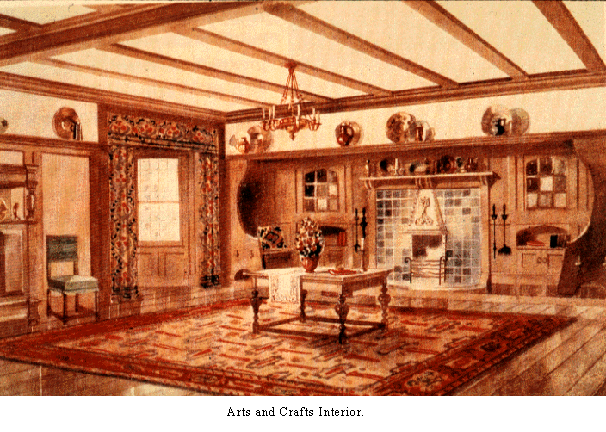
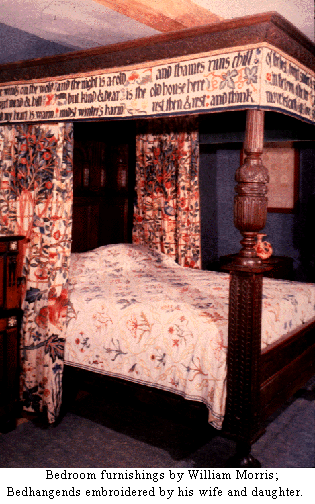
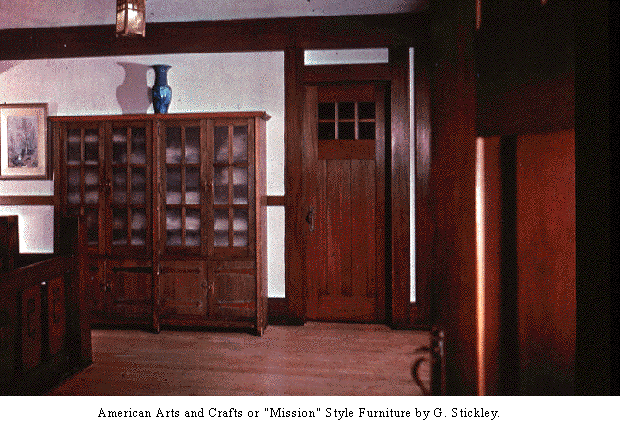
The Arts and Crafts movement initially developed in England during the latter half of the 19th century. Subsequently this style was taken up by American designers, with somewhat different results. In the United States, the Arts and Crafts style was also known as Mission style.This movement, which challenged the tastes of the Victorian era, was inspired by the social reform concerns of thinkers such as Walter Crane andJohn Ruskin, together with the ideals of reformer and designer, William Morris. (This link will take you to a less visual site that provides William Morris historical background).
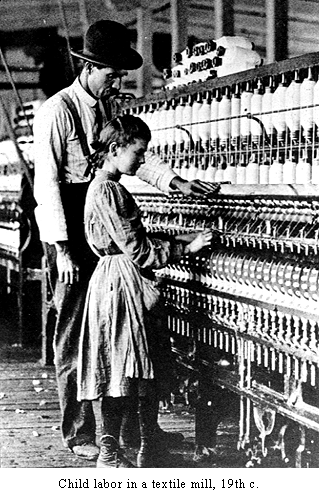
Their notions of good design were linked to their notions of a good society. This was a vision of a society in which the worker was not brutalized by the working conditions found in factories, but rather could take pride in his craftsmanship and skill. The rise of a consumer class coincided with the rise of manufactured consumer goods. In this period, manufactured goods were often poor in design and quality.Ruskin, Morris, and others proposed that it would be better for all if individual craftsmanship could be revived-- the worker could then produce beautiful objects that exhibited the result of fine craftsmanship, as opposed to the shoddy products of mass production. Thus the goal was to create design that was... " for the people and by the people, and a source of pleasure to the maker and the user." Workers could produce beautiful objects that would enhance the lives of ordinary people, and at the same time provide decent employment for the craftsman.
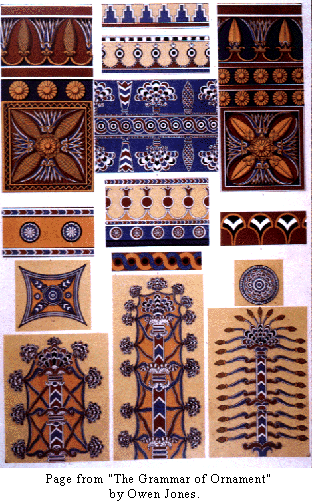
Medieval Guilds provided a model for the ideal craft production system. Aesthetic ideas were also borrowed from Medieval European and Islamic sources. Japanese ideas were also incorporated early Arts and Crafts forms. The forms of Arts and Crafts style were typically rectilinear and angular, with stylized decorative motifs remeniscent of medieval and Islamic design. In addition to William Morris, Charles Voysey was another important innovator in this style. One designer of this period, Owen Jones, published a book entitled The Grammar of Ornament, which was a sourcebook of historic decorative design elements, largely taken from medieval and Islamic sources. This work in turn inspired the use of such historic sources by other designers.
However,in time the English Arts and Crafts movement came to stress craftsmanship at the expense of mass market pricing. The result was exquisitely made and decorated pieces that could only be afforded by the very wealthy. Thus the idea of art for the people was lost, and only relatively few craftsman could be employed making these fine pieces. This evolved English Arts and Crafts style came to be known as"Aesthetic Style." It shared some characteristics with the French/Belgian Art Nouveau movement, to be discussed below.


However in the United States, the Arts and Crafts ideal of design for the masses was more fully realized, though at the expense of the fine individualized craftsmanship typical of the English style. In New York, Gustav Stickley was trying to serve a burgeoning market of middle class consumers who wanted affordable, decent looking furniture. By using factory methods to produce basic components, and utilizing craftsmen to finish and assemble, he was able to produce sturdy, serviceable furniture which was sold in vast quantities, and still survives. The rectilinear, simpler American Arts and Crafts forms came to dominate American architecture, interiors, and furnishings in the late nineteenth and early twentieth century.
Today Stickley's furniture is prized by collectors, and the Stickley Company still exists, producing reproductions of the original Stickley designs.


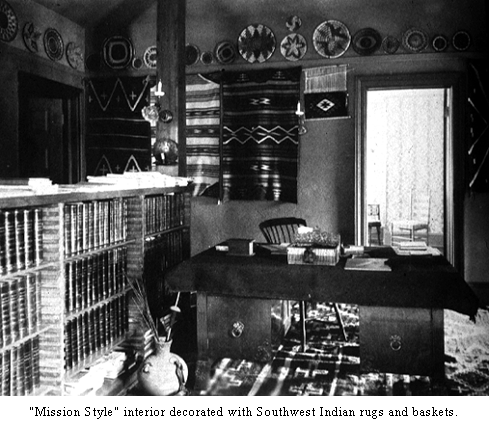
The term Mission style was also used to describe Arts and Crafts Furniture and design in the United States. The use of this term reflects the influence of traditional furnishings and interiors from the American Southwest, which had many features in common with the earlier British Arts and Crafts forms. Charles and Henry Greene were important Mission style architects working in California. Southwestern style also incorporated Hispanic elements associated with the early Mission and Spanish architecture, and Native American design. The result was a blending of the arts and crafts rectilinear forms with traditional Spanish colonial architecture and furnishings. Mission Style interiors were often embellished with Native American patterns, or actual Southwestern Native American artifacts such as rugs, pottery, and baskets. The collecting of Southwestern artifacts became very popular in the first quarter of the twentieth century.

Art Nouveau

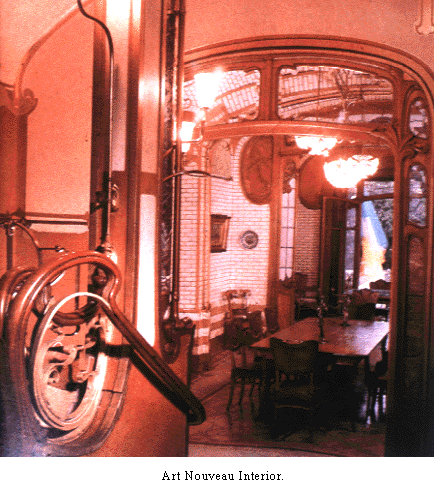
This style, which was more or less concurrent with the Arts and Crafts style, was not at all concerned with the social reform movements of the day. Instead, it addressed the clutter and eclecticism of mid-19th century European taste. Originating in Belgium and France, this movement advocated nature as the true source of all good design. Art Nouveau designers objected to the borrowing of design ideas from the past, and even from other cultures, although the Japanese approach to nature was much admired and emulated.
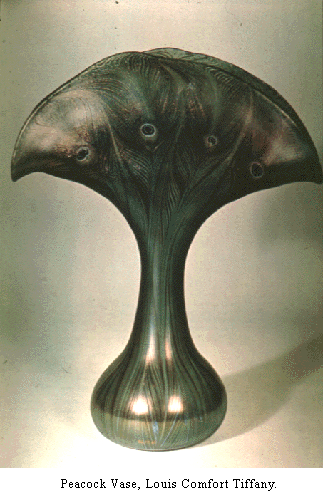
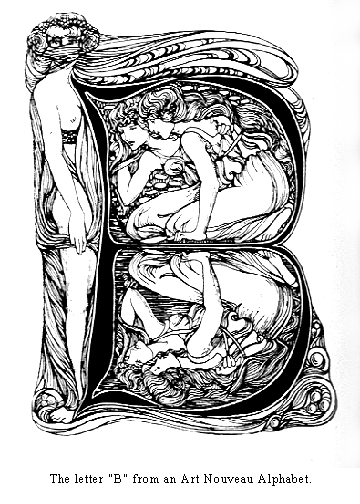
The characteristics of the style included above all the use of the sinuous curved line, together with asymmetrical arrangement of forms and patterns. The forms from nature most popular with Art Nouveau designers were characterized by flowing curves-- grasses, lilies, vines, and the like. Other, more unusual natural forms were also used, such as peacock feathers, butterflies, and insects.


Architects and designers who contributed to the development of this style included Victor Horta Hector Guimard (Click on Buildings and Subway in TOC on left), and Henry van de Velde. The glass and jewelry design of Lalique, as well as the stained glass and other designs of Louis Comfort Tiffany and Emile Galle (nice video at bottom of page) were important examples of Art Nouveau style.
A distinctive graphic design style developed, which included typography styles as well as a distinctive manner of drawing the female figure. The prints of Aubrey Beardsley and Alphonse Mucha are typical of this style.